
What do 55+ and 62+ labels mean?
We constantly see property owners and renters misunderstand age-restricted housing rules in our work as a professional service team. These misconceptions often lead to costly compliance issues when evaluating 55 plus vs 62 plus apartments, since federal fair housing law generally prohibits familial status discrimination. The rules require strict attention to detail.
Our team tracks these regulatory details carefully to help you make informed decisions. A community can limit residents by age only if it follows the hopa 55 and older guidelines or a similar exemption, with the two common versions being 55+ and 62+. A single Fair Housing Act violation can result in a first-offense HUD civil penalty of up to $26,262 in 2026.
We have listed the four tracked new communities carrying these labels as of Oct 25, 2026, on our 55+ new apartments page, and below we will clarify the specific rules you should know before signing a lease.
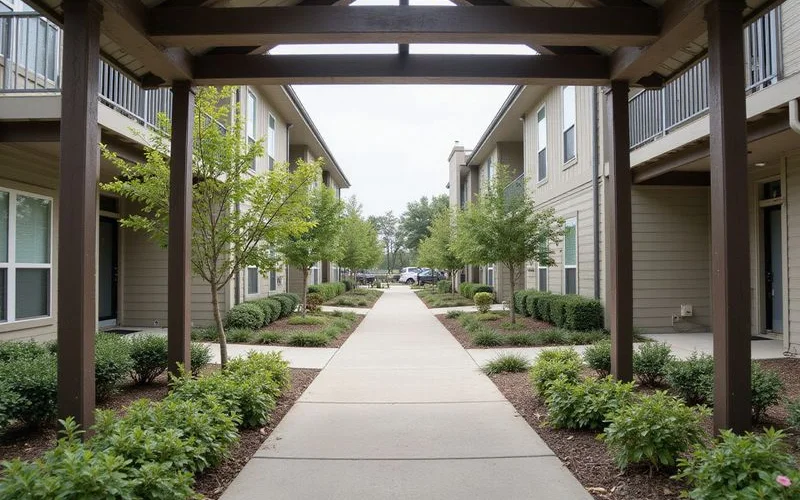
55 plus vs 62 plus apartments at a glance
A simple comparison helps explain the core differences between these two property types. The 55+ exemption under federal law requires at least one person 55 or older to live in at least 80% of the occupied units. This requirement is widely known in the industry as the 80/20 rule.
Our clients often confuse this with the stricter 62+ requirement. The 62+ designation mandates that 100% of residents must be 62 or older, with very narrow exceptions. Many of these 62+ communities operate under the HUD Section 202 Supportive Housing for the Elderly program.
We see that each community writes its own policy within these baseline rules. Ask for the specific property guidelines in writing before submitting an application. This simple step prevents any confusion later on.
| 55+ community | 62+ community | |
|---|---|---|
| Basic rule | At least one resident 55 or older in at least 80% of occupied units | Every resident 62 or older, with limited exceptions |
| Younger residents | Often allowed, per policy (up to a 20% buffer) | Rarely allowed |
| Verification | Written policy, usually ID at application | Written policy, usually ID for every resident |
| Common in | Market-rate and LIHTC communities | Often HUD Section 202, LIHTC, and affordable programs |
How communities verify age
Our team finds that verifying the senior apartment age requirement usually happens at application or lease signing. The community asks for government-issued ID, like a driver’s license or passport, for the qualifying resident or for every resident. HOPA also requires 55+ communities to verify occupancy regularly.
We confirm that properties must conduct these verification surveys at least once every two years. Property managers often use updated signed affidavits or specialized compliance software like TenantEvaluation to maintain this required audit trail. Failing to keep these biennial records can void the community’s HOPA exemption entirely.
Our practice is to share each community’s written policy before you apply, so there are no surprises at the desk.
Labels are sourced and dated
On our board, every 55+ or 62+ label shows where it came from and when we confirmed it. Pending labels, like Campanile on Minimax, stay marked until confirmed.
Which tracked new builds carry age labels?
We actively monitor the market for new senior housing developments across the region. Age-restricted buildings often participate in affordable housing programs. The Low-Income Housing Tax Credit (LIHTC) program is very common in these properties.
Our data indicates that LIHTC properties typically cap tenant income at 60% of the Area Median Income (AMI). This income limit stacks directly on top of the age requirement. The current list highlights properties carrying these labels as of Oct 25, 2026.
- The Laurel at Blackhawk, 55+, with 89 of 120 units under LIHTC
- Oakwood Trails, 62+, all units income-restricted
- Ivy Point Cinco Ranch, 55+
- Springwood at Aliana, 55+
We clarify that when a building has both an age rule and an income limit, both apply simultaneously. You must qualify under both sets of guidelines to secure a lease. The explanation on our 55+ with income limits page details exactly how they combine.

How we handle age labels under fair housing
Our firm operates in strict compliance with the Fair Housing Act, also known as Title VIII of the Civil Rights Act of 1968. Fair housing law protects familial status and other protected classes from discrimination. Age-restricted communities operate under a specific, legal exemption.
We treat these property labels as concrete facts. The Department of Justice actively enforces these laws, and property steering carries massive legal liabilities. Treating these labels seriously protects everyone involved.
Our agents never steer anyone toward or away from a building based on demographics. You receive personalized recommendations based only on what you tell us directly. The details on our fair housing page explain this approach clearly.
Questions to ask a 55+ or 62+ community
We recommend asking very specific questions to understand a property’s unique guidelines. Many 55+ communities act as if they are 100% restricted just to maintain a safe 20% compliance buffer. This buffer prevents them from accidentally dropping below the 80% minimum required by HUD.
Our clients find the most success when they request these operational details upfront. Property managers should readily provide this documentation. Reviewing the answers gives you a clear picture of the community rules.
- Is the community 55+ or 62+, and can I see the written policy?
- How do you verify age, and for which residents?
- Can a younger spouse, partner or caregiver live in the unit?
- Are any units income-restricted, such as capping at 60% Area Median Income?
- Which units are ground-floor or single-story, and is there elevator access?
How age rules interact with other residents
We know that community policies dictate exactly who else can live in or visit a unit. A spouse, partner, or other household member under 55 can often live with a qualifying resident in a 55+ community. This is only allowed if the community’s written rules explicitly permit it.
Our research shows that 62+ communities are usually much stricter. These properties feature very narrow exceptions, such as allowing certain on-site staff or licensed medical caregivers. Everyday exceptions for younger family members are practically non-existent in a 62+ environment.
We also urge buyers and renters to review the visitor guidelines. Most communities allow guests, but they enforce strict limits on how long a visitor can stay. Common guest restrictions include:
- Limiting visitors to 14 consecutive days.
- Capping total guest stays at a maximum of 30 days per calendar year.
- Requiring formal registration for any guest staying longer than a weekend.
Our team suggests asking for the official guest policy along with the age policy to prevent future conflicts. These documents provide peace of mind before you sign a lease. Visitors are always subject to the same community standards as residents.
How do we help?
We make finding the right age-restricted community straightforward and stress-free. Send us your move date, unit needs, and budget. An agent will confirm each community’s age policy and label source.
Our team will line up tours for you on the exact same day during business hours. This service is completely free to you. Your rent remains exactly the same either way.
We encourage you to reach out today to start planning your next move, whether you are comparing 55 plus vs 62 plus apartments or exploring other options.