
We see it all the time with clients finalizing a lease. Many people assume they can simply shop around for the lowest kilowatt-hour rate, especially when comparing a centerpoint vs entergy apartment electricity setup. The reality is that your specific location completely dictates your options. Our goal is to clarify this confusing utility landscape before you compare new apartments in Houston. Let’s break down the specific regional data, how delivery charges function, and the exact steps to avoid overpaying.
Can I pick my own electric plan at a new Houston apartment?
Our tracked board of new builds shows that most properties let you shop around. Out of 140 tracked locations as of October 25, 2026, you can choose your own plan at 123 of them. The remaining buildings use a different setup entirely. We want to help you understand which system applies to your next home. Texas operates on a split energy system.
In most of the Houston area, a delivery utility owns the wires while a retail company you choose sells the actual power. Some outlying areas rely on one utility to do both jobs, meaning there is absolutely no shopping around in those specific zones. Here is how the tracked board breaks down:
| Electric setup | Buildings (of 140) | Can you choose a plan? |
|---|---|---|
| CenterPoint Energy delivery area | 123 | Yes, on Power to Choose |
| Entergy Texas | 10 | No |
| Mid-South Electric Cooperative | 1 | No, co-op membership |
| Electric included or billed by the property | 5 | No, it’s in your lease |
| Unresolved | 1 | We’re confirming it |
How does CenterPoint’s area work?
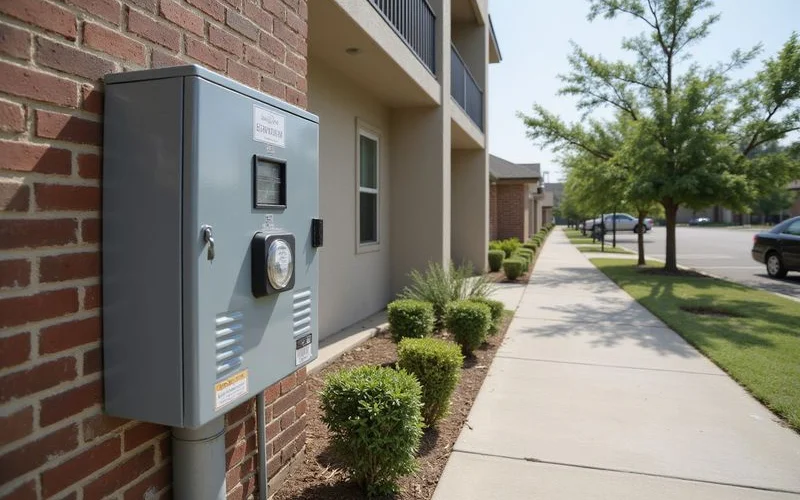
CenterPoint Energy owns the poles, wires, and meters across most of Harris County and much of Fort Bend. The company does not sell you electricity directly, so you must pick a retail provider to supply your power to choose apartment setup. This official comparison site is run by the Public Utility Commission of Texas (PUCT). Our team always recommends reading the fine print before clicking sign up.
CenterPoint passes a regulated delivery charge through your chosen plan to cover infrastructure costs. The PUCT increased this rate in October 2026 to $4.90 a month plus 6.5333 cents per kWh. Some retail plans fold this delivery fee into one flat rate. Other plans list it separately as a pass-through charge.
We suggest reviewing the Electricity Facts Label carefully for these specific details:
- Contract length. Match the duration to your lease term, or pick a month-to-month option if you might move soon.
- Early cancellation fee. Moving out can trigger heavy penalties unless the provider explicitly waives the fee for a change of address.
- Usage tiers. Many plans look cheap only at one exact usage level, so a slight increase in consumption can double your bill.
- Prepaid options. State law under 16 TAC §25.498 prevents prepaid plans from charging a security deposit.
What about Entergy Texas and Mid-South?
Entergy Texas serves parts of Montgomery and Liberty counties, including Conroe, Willis, and Dayton. If you lease an entergy texas apartment, the utility sells you power directly at a regulated rate in these locations. We cannot emphasize enough that you cannot shop for a plan in an Entergy zone. The company sets your rate, and they cap any required deposit at one-sixth of your estimated annual billing. Entergy is currently investing heavily in regional grid resiliency, including generation projects like the Orange County Advanced Power Station, which influences these regulated rates.
Mid-South Electric Cooperative serves The Terrace at Pine Lake Cove on our tracked board. A cooperative operates differently by requiring a $75 membership fee to join. You start service directly with the co-op rather than a retail provider.
Our data from the U.S. Energy Information Administration (EIA) shows Mid-South residential customers paid an average of 15.37 cents per kWh in 2025. One building, 1 Riva Row, was still unresolved on October 25, 2026, and will remain marked until confirmed.
Why this matters for your budget
In CenterPoint’s area, shopping can change your bill a lot. In an Entergy or co-op area, your rate is set, so we budget from the utility’s published rate and your unit size.
Which buildings include electric?
A handful of new buildings put electricity directly into your rent or bill it themselves. Our board highlights UNITi Montrose, Campanile on Minimax, The Levy, and The Studios at Channelview as properties that include electricity. The cards for these locations state this clearly.
We never add a separate electric line to your true monthly estimate for these specific properties. Included electricity is a simple convenience, but it can come with strict usage caps or flat fees. Recent EIA data shows a typical Texas one-bedroom apartment uses between 574 and 732 kWh per month.
You should use that benchmark to evaluate if a flat fee is truly a fair deal. We always ask property managers how their internal billing works at each building.

When should I set up service?
We advise following these specific timelines for your utility setup:
- CenterPoint areas: Pick a plan three to five business days before move-in so power is on when you arrive.
- Entergy or Mid-South zones: Call at least a week ahead to arrange your required deposit or membership.
Our detailed guide to setting up electricity walks through each process step by step. Planning ahead prevents expensive same-day connection fees.
Relocating from out of town is easier when you check the moving to Houston page, which shows electric, water, and school district information at a glance for each neighborhood. We designed these tools to help you coordinate every utility effortlessly.
How do I read an electricity fact label?
Every retail plan in CenterPoint’s area comes with an Electricity Facts Label (EFL). This document is the most useful page when you shop on Power to Choose. It shows exactly what you will actually pay at different consumption levels.
We highly recommend looking for these four critical details:
- Average price at 500, 1,000 and 2,000 kWh. Pick the column closest to your expected use. A one-bedroom unit often sits nearer the lower end, while a larger apartment trends nearer the middle.
- Delivery charges. Some providers pass CenterPoint’s $4.90 a month plus 6.5333 cents per kWh (PUCT, Oct 2026) through as a separate line item. Other companies fold it into one single rate.
- Bill credits. Certain plans look cheap only if you hit an exact usage window. Missing that specific target by just ten kilowatts can raise your bill substantially.
- Contract length and early termination fee. Match the term to your lease duration. You should also check whether the plan waives the penalty when you move to a new address.
What about summer bills?
Air conditioning drives almost all Houston utility costs. Your actual summer bill depends heavily on several architectural factors:
- Window direction: A top-floor unit facing west runs much warmer than a lower unit facing north.
- Insulation quality: Upgraded energy-efficient windows can reduce cooling loads by nearly twenty percent.
- Floor level: Heat rises, making upper apartments naturally warmer in August.
We know that summer peaks for a standard Texas one-bedroom apartment often hit 900 kWh. Asking what similar units averaged last summer is a great strategy. This context helps you pick a plan sized for your real use rather than a random guess.
How do we check the provider?
Our team checks every building’s physical address instead of just its mailing city. Two buildings with the exact same mailing city can sit in entirely different service areas. This happens frequently at the outer edge of Montgomery County.
The electric chip on each property card displays the current provider and the date it was verified. We update this information constantly to ensure accuracy.
Send us your exact move date and the buildings you are currently considering. Our specialists will confirm the electric setup at each address and add a precise estimate to your true monthly cost. You will receive this custom breakdown the same day during business hours.